
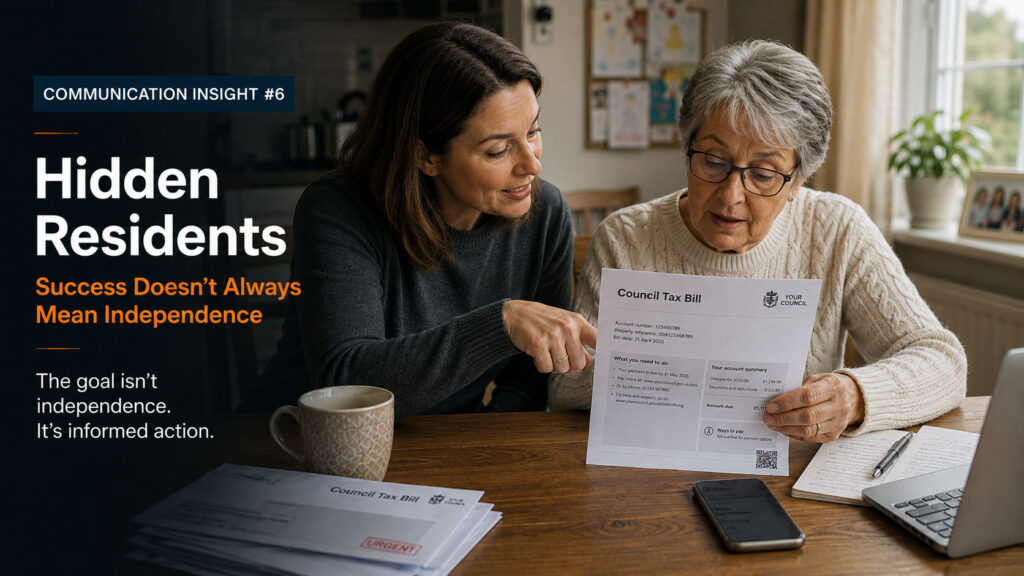
Success Doesn’t Always Mean Independence
Most organisations measure success by outcomes;
The form was submitted. The benefit was awarded. The Direct Debit was set up. The event was advertised. The consultation was published. The outcome was achieved.
These are sensible measures. They tell us whether services are working.
But they don’t always tell us how those outcomes were achieved.
And they rarely tell us who quietly missed out altogether.
Two Residents. One Outcome.
Imagine two residents renewing exactly the same council service online. Both successfully complete the transaction. Both set up a Direct Debit. Both leave exactly the same digital footprint.
From the council’s perspective, they are identical.
Now imagine the reality. The first resident completed everything independently. They understood the communication. They understood the choices available to them. They decided what to do and completed the process themselves.
The second resident relied entirely on someone else.
A husband.
A daughter.
A neighbour.
A friend.
A support worker.
Someone else explained every page. Every instruction. Every decision.
The council records two successful outcomes. But they are not the same.
One resident achieved independence. The other achieved the outcome because someone else supplied the understanding.
Neither outcome is wrong. Support is often essential and should always be available.
The question is different.
Could more people have achieved that same outcome independently if the communication itself had created understanding?
The Cost We Rarely See
Supported dependence has a cost. Not because support is a problem. But because unnecessary dependence is.
That cost is rarely measured but it has a measure.
It is measured in evenings spent helping someone complete a form. In family members explaining the same letter again and again.
In support workers reading information aloud. In neighbours translating complicated processes.
In parents giving up their own time so someone else can participate.
The organisation achieves its outcome. Someone else quietly provides part of the capacity.
That cost rarely appears anywhere.
Yet it is real.
Beyond Services
The Communication Gap doesn’t only affect access to services.
It affects access to life.
Imagine a council publishes its annual events guide.
It contains:
- Concerts.
- Street performers.
- Community events.
- Children’s activities.
- Local history walks.
- Volunteer opportunities.
- Information about everything happening across the borough.
Many residents quickly decide where they want to go. Others open the guide and feel overwhelmed.
Too much information. Too many pages. Too many assumptions.
They close it. They stay at home.
The council never knows. There is no complaint. No enquiry. No abandoned transaction. No performance measure.
Yet someone has just missed an opportunity to spend time with their family.
To meet new people.
To hear live music.
To become part of their community.
Not because the opportunity didn’t exist. But because understanding never did.
The Residents We Never See
By now we’ve explored how the Communication Gap affects customer contact. How it contributes to avoidable demand. How it consumes organisational capacity.
But there is another consequence.
Some people never contact us. Some rely on others. Some quietly disengage.
Some simply conclude that something “isn’t for people like me.”
These are the Hidden Residents.
Not because organisations don’t care. Not because anyone intended to exclude them. But because the Communication Gap often leaves no evidence behind.
Silence is easy to mistake for success.
Sometimes it is.
Sometimes it isn’t.
The challenge is that organisations rarely have a way of knowing the difference.
Why This Matters
Councils exist to deliver services.
But they also exist to strengthen communities. To help people participate. To reduce isolation. To improve wellbeing. To create opportunities.
Communication is how people discover those opportunities.
When communication creates understanding, people are better able to make informed choices about their own lives.
Sometimes those choices lead to independent action. Sometimes they lead to asking for support.
Both are successful outcomes when they begin with understanding.
The problem is not that people need support.
The problem is when they need support simply because the communication failed to create understanding in the first place.
Where Vera Fits
This is where Vera contributes.
Its purpose isn’t simply to simplify documents. It is to increase the number of people who can understand information well enough to participate more independently in the life of their community.
Sometimes that means completing a transaction. Sometimes it means applying for support. Sometimes it means attending a local event. Sometimes it means understanding a consultation well enough to have a voice.
Vera doesn’t replace families, carers or advocates.
It helps ensure their time is spent supporting people where it adds the greatest value, rather than first translating communication that could have been understood from the outset.
Because independence is about more than completing a form.
It is about giving people the confidence, dignity and opportunity to participate in society on their own terms.
Thought to Leave You With
The greatest consequence of the Communication Gap isn’t always the demand it creates for organisations. Sometimes it’s the opportunities people never knew they had.
About the Communication Insights series
This briefing is the sixth in a series exploring The Communication Gap—how organisations can strengthen their communication capability to ensure more people understand, access and benefit from the services available to them.
The insights are based on our work with public sector organisations and the thinking that has shaped the evolution of Ask Vera from an AI-powered Easy Read & Plain English platform towards a broader communication platform designed to help organisations close the Communication Gap.
